Most people planning a build in Nepal collect two or three quotations, pick the middle one, and sign. That is where the trouble usually starts, because a per square foot figure tells you almost nothing about what is actually included, whether the contractor is licensed for the size of your project, or whether anyone on the payroll is registered with the Nepal Engineering Council.
This guide covers the numbers and the parts quotations leave out: current construction cost in Nepal per square foot, what those rates exclude, what the A to D licence classes mean for you as a client, and the checks to run before money changes hands.
Table of Contents
Quick answer: what does it cost to build in Nepal?
Building in Nepal in 2026 costs roughly NPR 2,500 to 3,500 per square foot for a basic finish, NPR 3,500 to 4,800 for a standard finish, and NPR 5,000 to 7,000 or more for premium work, calculated on built up area.
Kathmandu Valley generally runs 10 to 20 per cent above rates elsewhere in the country. The quoted rate covers civil work and finishing only. Land, design fees, the naksa pass, utility connections and interiors all sit on top of it, so budget a further 15 to 25 per cent beyond the construction figure.
Construction cost in Nepal per square foot, 2026
The figures below are market ranges observed across the Nepali construction sector in 2026. They apply to built up area across all storeys and cover civil work and finishing only.
| Finish level | Rate per sq ft (NPR) | What it covers |
| Basic | 2,500 to 3,500 | Structure, basic plaster, standard tiles and fittings, functional plumbing and electrical |
| Standard | 3,500 to 4,800 | Better tiles and sanitaryware, quality doors and windows, improved electrical layout |
| Premium | 5,000 to 7,000+ | Modular kitchen, false ceiling, imported fittings, feature finishes, designed lighting |
Worked example. A three storey house with 600 sq ft per floor is 1,800 sq ft built up. At a standard finish of NPR 3,800 per sq ft, that is roughly NPR 68 lakh, and closer to NPR 82 lakh once a Kathmandu Valley loading of about 20 per cent is applied. Boundary wall, parking, landscaping and utility connections sit on top of that.
If you are working from a plot size rather than a floor plan, our area calculator will convert anna and ropani into built up area first.
What these figures look like on real projects
Rates in isolation are hard to judge. Here is the scale of hospitality and commercial work we have delivered in Nepal, with the sizes and dates that sit behind our own cost planning.
| Project | Location | Built up area | Capacity | Completed |
| Imperial Banquet Itahari | Itahari, Sunsari | 1,500+ guests | Completed | |
| Rambagh Mahal | Lalitpur | 22,000 sq ft | 1,200+ guests | Completed |
| Sangam Batika | Balaju, Ring Road | 20,000 sq ft | 1,500+ guests | Completed |
| Ramalaya | Bansbari, Budhanilkantha | 19,000 sq ft | 2000+ guests | Completed |
| Harshah Batika | Lalitpur | 11 ropani site | 3000+ guests | Completed |
| Royal Empire Boutique Hotel | Kathmandu | 15 rooms | 500+ guests | Completed |
Commercial hospitality work sits well above residential rates. A banquet hall carries long structural spans, commercial kitchen services, high occupancy fire provision and acoustic treatment that a house never needs. Treat the residential table above as a floor, not a guide, if you are developing a venue.
How construction cost varies by city
Kathmandu Valley is the most expensive market in Nepal, driven by labour rates and site logistics. Pokhara, Biratnagar, Butwal, Chitwan and Birgunj generally run 15 to 20 per cent lower on labour.
Remote sites can add 15 to 30 per cent to material cost through transport alone, which often outweighs the labour saving. Access road condition matters more than distance on paper.
We have built outside the Valley as well as in it. Imperial Banquet Itahari, a 1,500 capacity venue in Sunsari completed in 2019, was a useful lesson in this: labour was cheaper than Kathmandu, but specialist finishes, lifts and kitchen equipment all had to be scheduled around transport from the Valley or across the border, and that scheduling drove the programme more than the trade rates did.
What moves the number most
Finish specification is the single largest variable, capable of shifting NPR 1,000 to 2,500 per sq ft on its own. The difference between the basic and premium rows above is almost entirely an interior design decision rather than a structural one, which is why it pays to settle the specification before you sign rather than during construction. Our guides to interior design in Kathmandu and living room design cover where that money actually goes.
After specification, the biggest cost drivers are:
- Sloped or poor bearing ground requiring retaining walls or piling
- Plan complexity such as cantilevers, curved walls and double height spaces
- Ceiling height above the standard 10 feet
- The number of bathrooms and wet areas
- Basement construction and lift provision
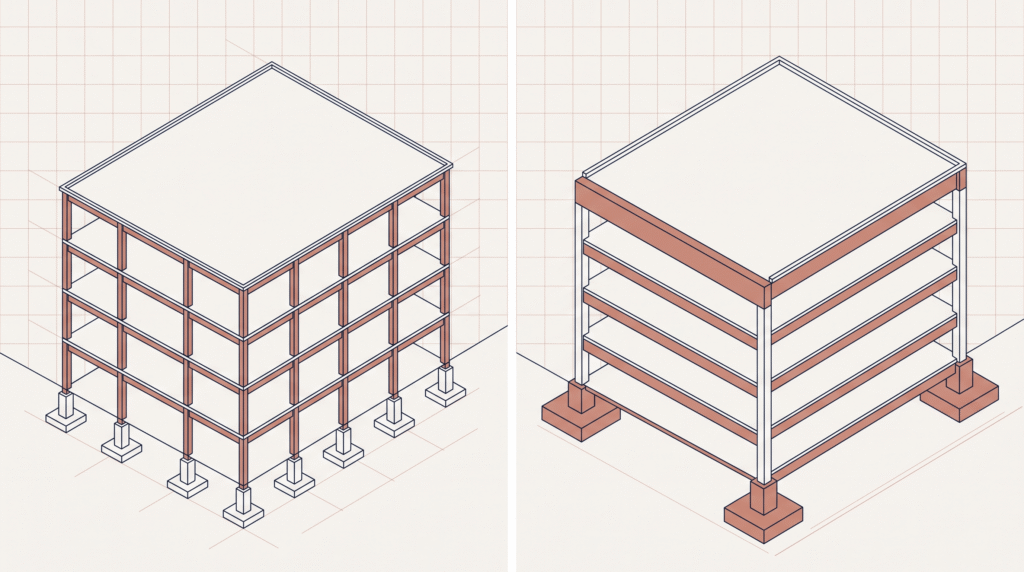
- Long clear spans, which is where commercial work separates sharply from residential
That last one is worth explaining, because it is invisible on a floor plan. At Sangam Batika in Balaju we designed one of the largest column free floorplates in the Valley at 20,000 sq ft. Removing columns from an event hall is a client requirement that reads as a single line in a brief, and it changes the entire structural solution underneath: deeper beams, heavier reinforcement, larger foundations. The same square footage with columns every six metres costs materially less.
Site constraints do the same thing. At Ramalaya in Bansbari, placing a high capacity venue inside a residential neighbourhood meant engineering external sound buffering and a valet flow system to keep guest arrivals off local Budhanilkantha streets. Neither appears in a per square foot rate, and both were fixed by the site rather than the brief.
Material and labour rates, early 2026
Steel is running around NPR 120 to 140 per kg and standard bricks around NPR 15 to 22 each in Kathmandu. Labour accounts for roughly 25 to 40 per cent of total cost, with a skilled mason in the Valley at NPR 1,500 to 2,000 per day.
Sector costs have been rising in the range of 7 to 10 per cent annually, driven by material prices and a shortage of skilled labour. Rates move, so treat these as a planning baseline and get a current itemised quotation for your specific site.
What the per square foot rate does not include
This is where most budget shocks originate. A per square foot construction rate almost never covers:
- Land, and the transfer costs on it
- Architectural design and structural engineering fees
- Municipal building permit (naksa pass) fees and drawing submissions
- Soil investigation, where the site requires it
- MEP systems beyond basic domestic plumbing and wiring, such as HVAC, fire suppression or backup power
- Boundary walls, gates, parking slabs and site levelling
- Water, electricity and sewerage connections and deposits
- Interior fit out, loose furniture and appliances
- Landscaping
Add a contingency of 10 to 15 per cent. Material prices in Nepal fluctuate and unexpected ground conditions are common.
The three ways contractors charge in Nepal
The price gap between these arrangements is large, and confusing one for another is a common reason a budget blows out.
Labour only contracting. The contractor supplies workers and supervision. You buy every bag of cement, every rod, every tile. Cheapest headline rate, most work for you, and highly exposed to material price swings.
Labour plus material. The contractor supplies both at an agreed per square foot rate against an agreed specification. This is the most common arrangement for private homes in Nepal. It only works if the specification is written down in detail, because the specification is what you are actually buying.
Turnkey or design and build. A single company handles design, structural engineering, approvals, construction, MEP and finishing through to handover. Higher rate, single point of accountability, and far less coordination risk for you. This is the usual route for commercial construction and for hotels, restaurants and event venues, where a design change discovered mid construction is expensive. For private homes the equivalent is a residential design and build arrangement.
There is a fourth option worth knowing about: construction project management, where a professional firm supervises a contractor on your behalf. If you are building from abroad or from another city, this is often cheaper than the mistakes it prevents.
Contractor licence classes in Nepal: A, B, C and D
Construction companies in Nepal are classified into four grades under the Construction Business Act, 2055 (1999) and the Construction Business Rules, 2056 (2000). Classification is based on paid up capital, technical manpower, owned or leased equipment, and track record.
The Department of Urban Development and Building Construction (DUDBC) issues national level classification, while municipalities maintain their own registers under the Local Government Operation Act, 2074.
| Class | Typical project scope | Technical staff commonly required |
| A | Large national and international works, no upper project value limit | Multiple engineers, substantial plant and machinery |
| B | Medium to large projects nationally | At least one engineer and one overseer |
| C | Medium scale and regional works | At least one sub engineer or equivalent |
| D | Entry level, small local works | At least one certified sub engineer |
Two things clients get wrong here.
First, a higher class is not automatically better for you. An A class firm geared for highway contracts is not necessarily the right choice for a 2,000 square foot house. What matters is that the class comfortably covers your project value and that the company's completed work resembles yours.
Second, classification certificates are generally issued for a fiscal year and must be renewed. A licence photocopy from three years ago proves nothing. Ask for the current certificate and check the validity date.
Seven checks to run before you sign
- Company registration and PAN or VAT. Ask for the certificate from the Office of the Company Registrar and the tax registration. An unregistered company leaves you with no legal recourse.
- Current contractor classification certificate. Check the class and the expiry date, not just that a certificate exists.
- A registered engineer, by name. Nepal Engineering Council registration is verifiable. Ask who specifically will stamp your structural engineering drawings and who will be on site each week.
- Two completed projects you can visit. Not photographs. Walk a finished building, speak to the owner, and read any construction case studies the company publishes. Ask the owner about the final month of the project, which is when problems surface.
- An itemised bill of quantities. A single per square foot figure is a sales tool, not a contract. The BOQ should name brands, grades and quantities: cement grade, steel brand and diameter, brick class, tile size, sanitaryware make. If you are not confident reading one, an independent cost consultancy review is worth the fee.
- Written seismic compliance. NBC 105:2020 applies to residential construction, and a building that does not comply will struggle to obtain a completion certificate from the municipality. Compliance typically adds around 8 to 12 per cent to structural cost and is not the place to economise in Nepal.
- A payment schedule tied to milestones. Payments should release against completed and inspected stages, never against a calendar.
On larger or commercial sites, run a project feasibility study before any of this. Zoning limits, access and utility availability decide what you can build, and finding out after design is expensive.
Red flags. A quotation on a single page with no BOQ, reluctance to name the engineer, a demand for a large advance before any work, verbal only variations, and a rate materially below every other bid. The last one almost always reappears later as a variation claim.
Contract types and payment structure
Lump sum. A fixed price for a defined scope. Good for you if the scope is genuinely fixed. It fails the moment you change your mind, because every change becomes a priced variation.
Item rate against BOQ. You pay for measured quantities at agreed unit rates. Fairer when quantities are uncertain, and it requires someone competent measuring work on your behalf.
Cost plus fee. You reimburse actual cost and pay an agreed margin. Transparent, but only workable with genuine open book accounting and a trusted contractor.
Whichever you use, the contract should specify the completion date and what happens if it slips, the defects liability period after handover, how variations are priced and approved in writing, and the retention held back until defects are cleared. Retention of around 5 per cent released after the defects period is normal practice and is your main leverage at the end of a project.
If you hold land but not the capital to build on it, there is a fourth route worth considering: a build, lease and partner arrangement, where the development is funded and operated against a lease rather than paid for upfront.
How design coordination affects your build cost
The cheapest changes are the ones made on a drawing. The most expensive are the ones made on site, and in Nepal a large share of cost overruns trace back to drawings that were never properly coordinated: a beam running through a duct, a bathroom stack with nowhere to go, a staircase that lost its headroom once the slab thickness was finalised.
This is what BIM and 3D modelling is for. Clash detection before construction is unglamorous and it removes a category of problem that otherwise gets discovered by a mason with a hammer. If a company cannot show you coordinated drawings across architecture, structure and services, expect variations.
For anything larger than a single plot, the same logic applies at site scale through master planning: access, parking, drainage and phasing decided upfront rather than improvised.
Planning a build?
We work as a turnkey construction company in Nepal, delivering design, engineering and site work under one contract. That means the drawings, the structural design and the build are the responsibility of the same people, which matters most on hospitality and commercial projects where a coordination failure between designer and contractor is expensive to unwind.
Our completed work includes Rambagh Mahal, the Ramalaya event venue and the Royal Empire Boutique Hotel, alongside luxury residential and nightclub construction projects. You can walk through the full project portfolio before speaking to anyone.
If you want a realistic cost picture before committing, we can review your site and requirements and prepare an itemised assessment.
Frequently asked questions
How much does it cost to build a house in Nepal in 2026?
Typical market rates run from about NPR 2,500 per square foot for basic work to NPR 7,000 or more per square foot for premium finishes, calculated on built up area. A 1,500 sq ft home at a standard finish in Kathmandu commonly lands between NPR 60 lakh and NPR 90 lakh for construction alone.
Does the per square foot rate include design and permit fees?
No. The construction rate covers civil work and finishing. Architectural and structural design fees, municipal building permit charges, soil testing, utility connections and interior fit out are all charged separately. Budget a further 15 to 25 per cent beyond the construction figure.
What are the construction company classes in Nepal?
Contractors are graded A, B, C and D under the Construction Business Act, 2055. The grade reflects capital, technical manpower and equipment, and it limits the value of work a company may legally undertake. Class A carries no upper project value limit, while Class D is the entry level category for small local works.
How do I check whether a construction company in Nepal is legitimate?
Ask for the company registration certificate, the PAN or VAT registration, and the current contractor classification certificate with its validity date. Confirm the engineer's Nepal Engineering Council registration, and visit at least two completed projects rather than relying on photographs.
Why is construction more expensive in Kathmandu?
Labour rates in the Valley are higher, sites are more constrained, and logistics such as material delivery and waste removal cost more in dense urban areas. Kathmandu typically sits 10 to 20 per cent above rates in Pokhara, Butwal or Biratnagar for equivalent work.
Is earthquake resistant design compulsory in Nepal?
Seismic design under NBC 105:2020 applies to residential construction, particularly in urban areas. Buildings that do not comply face difficulty obtaining a completion certificate from the municipality. It typically adds around 8 to 12 per cent to structural cost.
How long does it take to build a house in Nepal?
For a standard three storey residential build, structural work commonly runs six to nine months, with finishing adding a further three to six months depending on specification. Permit timelines vary by municipality and should be planned separately rather than assumed.
How much contingency should I budget?
Ten to fifteen per cent above your agreed contract value. Material prices in Nepal fluctuate, ground conditions produce surprises, and most owners make at least one specification change during the build.